
Wednesday, November 11, 2026 | Today's Newsletter | Login
El Niño Deepens Philippine Farm Crisis
By Mata Press Service
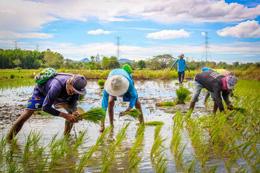
The Philippines is bracing for a deepening agricultural crisis after farm and fisheries production plunged to its lowest third-quarter level in 11 years, with a powerful El Niño threatening food supplies, water security and millions of livelihoods well into 2027.
Government figures show agricultural and fisheries output contracted by five percent between July and September, as flooding, rising fertilizer costs and unfavourable weather battered farmers and fishing communities.
The downturn comes as the government prepares for what meteorologists describe as a "very strong" El Niño, expected to bring prolonged drought, extreme heat and worsening water shortages across much of the archipelago.
The Philippine Statistics Authority (PSA) reported that agricultural and fisheries production fell to 389.42 billion pesos in the third quarter, down from 410.04 billion pesos a year earlier, measured at constant 2018 prices.
It was the sector's weakest third-quarter performance since 2015.
Crop production, which accounts for more than half of agricultural output, fell 9.3 percent to 197.71 billion pesos. Rice production declined 17.8 percent, corn dropped 17.4 percent and sugarcane suffered a 48.4 percent fall in production volume.
Fisheries production also weakened, with its value falling 8.5 percent to 50.86 billion pesos.
Livestock and poultry provided some relief, recording growth of 1.1 percent and 4.9 percent respectively, but those gains were insufficient to offset the broader downturn.
The Department of Agriculture blamed expensive fertilizers and other farm inputs, which discouraged planting, alongside destructive flooding caused by the southwest monsoon, locally known as habagat.
Roehlano Briones, senior research fellow at the Philippine Institute for Development Studies, also attributed the agricultural contraction largely to bad weather and the initial effects of El Niño, according to BusinessMirror.
Rice harvests under threat
The immediate concern is the country's rice supply.
The Department of Agriculture has identified approximately 2.26 million hectares of rice-growing land as vulnerable to El Niño, based on assessments by the Philippine Rice Research Institute.
More than one million hectares face moderate to high risks from insufficient rainfall and irrigation water.
Another 171,634 hectares are classified as very high risk, with authorities recommending that farmers switch to crops requiring less water.
About 128,172 hectares could become impossible to plant because of inadequate irrigation supplies. Farmers in those areas have been advised to suspend planting temporarily.
Government projections indicate that El Niño could reduce the country's palay, or unmilled rice, harvest by at least one million metric tons in 2026, bringing annual production down to approximately 18 million metric tons.
For a country where rice is the principal staple food, prolonged production losses could drive up prices, strain household budgets and increase dependence on imports.
The United Nations has warned that approximately 4.6 million Filipino farmers and fisherfolk could see their livelihoods affected by the developing crisis.
In an October 30 assessment, the UN said drought conditions could affect 54 provinces by the end of 2026, while 109 cities and municipalities had already declared a state of calamity.
One in every three barangays, the country's smallest administrative units, has been identified as vulnerable to water shortages.
The Philippine weather agency, PAGASA, confirmed on November 4 that a very strong El Niño was already present in the tropical Pacific and could persist through the first half of 2027.
Five provinces experienced meteorological drought in October, while 11 suffered dry spells and another 10 recorded dry conditions.
PAGASA expects below-normal rainfall across much of the country in November, accompanied by unusually high temperatures.
However, the agency cautioned that tropical cyclones could still bring destructive rainfall and flooding despite the drought.
Government mobilizes emergency response
President Ferdinand Marcos Jr.'s administration is mobilizing agencies to protect food production, water supplies and public health.
The United Nations reported that the government had allocated approximately US$123.2 million, or 7.8 billion pesos, for El Niño preparedness and response.
Separately, the Department of Agriculture has proposed a 61.99-billion-peso programme to protect agricultural production and rural livelihoods.
The two funding measures cover different priorities. The smaller allocation supports broader government preparedness, while the larger agricultural programme includes proposed spending that has yet to be fully funded.
According to the department, 6.2 billion pesos had been released under the government's UPLIFT programme, while another 371 million pesos in proposed interventions remained unfunded.
Agriculture Secretary Francisco Tiu Laurel Jr. said the government would focus on drought-resistant crops, improved irrigation systems, farm monitoring and targeted assistance.
"We have more tools now to mitigate the impact," he said, citing drought-resistant rice varieties, solar-powered irrigation and improved planting schedules.
The response plan also includes crop insurance, cloud seeding and livestock assistance.
"We need to plan ahead and ensure farmers have the support they need to cope with a potentially severe El Niño," Tiu Laurel said.
President Marcos has also instructed officials to examine importing drought-resistant rice seeds from India and expanding cloud-seeding operations.
Food security and health risks
The United Nations warned that prolonged drought could trigger consequences extending far beyond agriculture.
Reduced harvests, combined with rising fuel and transportation costs, could push food prices higher and weaken the purchasing power of vulnerable households.
"Reduced agricultural production can quickly translate into higher food prices, lower household incomes, and worsening food insecurity," the UN warned.
Extreme temperatures also increase the risk of heat-related illnesses and dehydration, particularly among children, older people and those with existing medical conditions.
Water shortages could undermine sanitation and healthcare services, while electricity demand could rise by as much as 10.7 percent as households and businesses increase cooling and water pumping.
The UN cautioned that food security problems could persist into the second quarter of 2027, even after El Niño reaches its peak.
For millions of Filipino farming families already struggling with rising costs and repeated weather disasters, another poor harvest threatens deeper financial hardship.
The coming months will test whether government intervention can protect the country's food supply before the drought delivers another devastating blow.
Leave a comment