
Wednesday, October 14, 2026 | Today's Newsletter | Login
"I live in constant fear"
By Shawgi Mustafa
Local Journalism Initiative Reporter
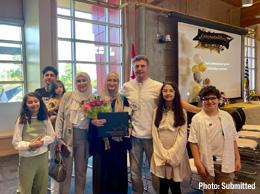
Jalal Alhamrawi and his family have lived in Surrey, B.C. for nearly 10 years and are still waiting to be accepted as permanent residents of their new country.
Their lives — his wife, Nada Chahade, and their six children — have been suspended between a rejected refugee claim, a removal order and immigration applications that they say have been “lost” somewhere along the way.
“We’ve been waiting from 2017 to 2026 with no decision,” Alhamrawi said.
“We can’t continue living like this for another five or 10 years.”
In 2017, the family arrived from Venezuela, where they had established a successful business. They entered Canada on valid tourist visas and filed for asylum three weeks later, Alhamrawi told New Canadian Media.
He said they had fled Venezuela after months of extortion attempts. Armed groups known as Colectivos demanded US$50,000 from Alhamrawi, threatening to kill him or kidnap his children.
The threats escalated to shots fired at the family home, and in April 2017, Alhamrawi said he was abducted and beaten.
Originally from Lebanon, the family moved to Venezuela in 2003 to build new lives and join relatives already settled there.
“The main problem didn’t start in Lebanon; it started in Venezuela,” Alhamrawi said.
“The Colectivo extorts local merchants. When they demanded a huge amount from me, I couldn’t pay. They threatened to kidnap one of my children.”
The gang warned Alhamrawi against returning to Lebanon, telling him he would be intercepted the moment he landed.
“I already had a Canadian (visitor’s) visa, so I came straight to Canada.”
Independent security research groups, including InSight Crime and the Center for a Secure Free Society (SFS), have documented overlaps between Venezuelan armed groups and Hezbollah operatives in South America.
In testimony before the U.S. House Foreign Affairs Committee, SFS executive director Joseph Humire described operational links between Venezuelan Colectivos and Hezbollah (listed as a terrorist organization in Canada) networks.
In 2018, Canada’s Immigration and Refugee Board (IRB) rejected the family's claim for asylum, concluding they could safely relocate to Lebanon.
“They said my problem in Lebanon was something I could overcome,” Alhamrawi said.
With the help of legal aid, the family appealed the decision, and in 2019, Canada's Federal Court refused leave for a judicial review.
When they lost their appeal for a judicial review, Alhamrawi said the family also lost their legal aid support to pursue a refugee claim.
They retained Delta-based immigration consultant Khan Mumtaz Ali, whose company is M. Khan & Company, and he agreed to challenge the unfavourable court rulings.
“He told me he would file an application with the Federal Court for a fee of $3,500,” Alhamrawi said.
Over the following years, Alhamrawi says he spent about $12,000 in legal and government fees. NCM has reviewed some receipts provided by the family to back his claim.
But according to Alhamrawi, between 2019 and late 2025, the family received unsatisfactory updates from the immigration consultant.
“Every time I went to see him, he told me there was no progress and asked for more reference letters (to support the refugee claim).”
In late 2025, Alhamrawi said he pressed for more details and Mumtaz Khan claimed the file had been lost. He retained another immigration consultant and discovered Mumtaz Khan had not pursued his case at all.
“When I finally collected the papers myself, I was shocked,” Alhamrawi said. “He only gave me the reference letters I had gathered from people. Nothing else.”
In a statement to NCM, Mumtaz Khan said the family retained his office to consider and pursue options after their refugee claims were refused, including a possible judicial review and an appeal on humanitarian and compassionate grounds.
“Following our assessment of the available record and applicable law, we advised that an application for judicial review had no reasonable prospect of success,” Mumtaz Khan said in his statement.
“Accordingly, no Federal Court application was filed or pursued.”
Mumtaz Khan rejected the suggestion that his office “knowingly accepted payment for an application while deliberately failing to file it.” He said it was inaccurate to say the family’s file had been lost, adding that the family had voluntarily removed their papers from his office.
In a statement to NCM, the College of Immigration and Citizenship Consultants (CICC) said it investigates complaints against licensed consultants.
Stef Lach, CICC’s public affairs manager, said individuals who suffer proven financial losses may be eligible for compensation through its Compensation Fund.
Complaints against immigration consultants can be filed on the College’s website.
In an emailed statement, Immigration, Refugees and Citizenship Canada (IRCC) confirmed the basic details of Alhamrawi’s case. A spokesperson said the family’s removal order from Canada has been stayed since 2020 by the Canada Border Services Agency (CBSA) under an “Administrative Deferral of Removal” for Venezuela because the deportation would threaten their lives.
Canada lists both Venezuela and Lebanon as unsafe for deportees.
IRCC also stated it has no record of any “humanitarian and compassionate application” for permanent residence filed on behalf of the Alhamrawi family.
NCM contacted the office of Randeep Sarai, Member of Parliament for Surrey Centre, after the family said they had sought his help to gain refugee status. The office did not provide comment and referred all inquiries to IRCC’s media relations department.
Alhamrawi said the toll on the family has been devastating. He suffers from severe depression and a herniated disc that prevent him from working.
“My daughter attempted suicide and went to the ER alone…
"I live in constant fear."
His eldest son has been unable to attend university because of the high tuition fees for non-Canadians and has been prescribed sedatives. And his eldest daughter, treated as an international student, can take only one or two courses per semester, stretching her undergraduate studies to more than a decade.
His youngest daughter, born in 2019, is a Canadian citizen.
In order to manage, the family now depends on social assistance, Canada Child Benefits, food banks and B.C. government-issued health cards, which will continue while the family’s removal order is on hold.
IRCC confirmed that the family is entitled to federal and provincial benefits since their removal from Canada has been stayed. They also have work permits, but these do not grant legal status and can only be renewed as long as their removal remains unenforceable.
Said Alhamrawi: “My concern isn’t just the immigration consultant — it’s knowing the fate of my file.”
Leave a comment